مقارنة تجريبية ووظيفية بين BigchainDB و SQL Server لإدارة البيانات
DOI:
https://doi.org/10.47372/p9ce1n35الملخص
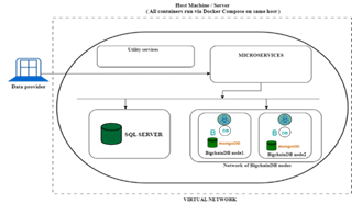
أدى النمو المتسارع للبيانات الرقمية إلى زيادة الطلب على أنظمة إدارة البيانات التي لا توفر فقط الأداء العالي وقابلية التوسع، بل توفر أيضًا ضمانات قوية للأمان والنزاهة والموثوقية. تقدم هذه الورقة مقارنة تجريبية ووظيفية بين SQL Server، وهي قاعدة بيانات علائقية تقليدية، وBigchainDB، وهي قاعدة بيانات لامركزية قائمة على تقنية Blockchain التي تدمج ميزات السجلات الموزعة مع إمكانيات قواعد البيانات. تم تنفيد كلا النظامين في بيئة محاكاة متطابقة باستخدام Docker لضمان تقييم عادل وقابل للتكرار. تم إنشاء مجموعة بيانات موحدة تحتوي على ما يصل إلى 100,000 سجل، واستُخدمت لتقييم أداء الإدخال، وزمن استجابة الاستعلام، وقابلية التوسع، واستهلاك موارد النظام (وحدة المعالجة المركزية والذاكرة). تمت مراقبة سلوك النظام باستمرار باستخدام Prometheus وGrafana. بالإضافة إلى مقاييس الأداء، تم تقييم المقاييس الوظيفية، بما في ذلك عدم قابلية التغيير( الثبات )، وإمكانية التتبع، والتحكم في الملكية.
تُظهر النتائج التجريبية أن SQL Server يحقق زمن استجابة أقل بكثير واستجابة أسرع للاستعلامات، ولكن على حساب زيادة استهلاك وحدة المعالجة المركزية والذاكرة. في المقابل، يُظهر BigchainDB استهلاكًا أقل للموارد، ويُوفر أمانًا قويًا وضمانات مقاومة للتلاعب، مع زيادة في زمن الاستجابة نتيجة لآليات الإجماع والتحقق من صحة المعاملات. تُسلط هذه النتائج الضوء على المفاضلة بين حلول إدارة البيانات المركزية واللامركزية، وتُقدم إرشادات عملية لاختيار التقنية المناسبة بناءً على متطلبات التطبيق من حيث الأداء والموثوقية والأمان.
التنزيلات
المراجع
1. S. Wilson et al., ‘Data Management Challenges in Blockchain-Based Applications’, IEEE Internet Comput., vol. 28, no. 1, pp. 70–80, Jan. 2024,
2. Q. Wei, B. Li, W. Chang, Z. Jia, Z. Shen, and Z. Shao, ‘A Survey of Blockchain Data Management Systems’, Nov. 25, 2021, arXiv: arXiv:2111.13683. Accessed: Sep. 22, 2024. [Online]. Available: http://arxiv.org/abs/2111.13683
3. P. Chitti, J. Murkin, and R. Chitchyan, ‘Data Management: Relational vs Blockchain Databases’, in Advanced Information Systems Engineering Workshops, vol. 349, H. A. Proper and J. Stirna, Eds., in Lecture Notes in Business Information Processing, vol. 349. , Cham: Springer International Publishing, 2019, pp. 189–200.
4. Monrat, O. Schelen, and K. Andersson, ‘A Survey of Blockchain From the Perspectives of Applications, Challenges, and Opportunities’, IEEE Access, vol. 7, pp. 117134–117151, 2019,
5. BigchainDB GmbH, Berlin, Germany ,‘BigchainDB 2.The Blockchain Database’, https://www.bigchaindb.com/whitepaper/bigchaindb-whitepaper.pdf, p. 14, 2018.
6. MongoDB. https://www.mongodb.com/
7. T. McConaghy et al., ‘BigchainDB: A Scalable Blockchain Database’, ascribe GmbH, Berlin, Germany, Jun. 2016.
8. Rustemi, V. Atanasovski, and A. Risteski, ‘Framework for Using BigchainDB in Software Application’, 2022.
9. T. I. Nurmamatovich, ‘The SQL server language and its structure’, American Journal of Open University Education, vol. 1, no. 1, 2024.
10. X. Chen, Y. Liu, and J. Ge, ‘A Data Management Method Based on Blockchain Technology’, in 2020 3rd International Conference on Smart BlockChain (SmartBlock), Zhengzhou, China: IEEE, Oct. 2020, pp. 203–208
11. J. Chen, Z. Lv, and H. Song, ‘Design of personnel big data management system based on blockchain’, Future Generation Computer Systems, vol. 101, pp. 1122–1129, Dec. 2019
12. S. Lupaiescu, P. Cioata, C. E. Turcu, O. Gherman, C. O. Turcu, and G. Paslaru, ‘Centralized vs. Decentralized: Performance Comparison between BigchainDB and Amazon QLDB’, Applied Sciences, vol. 13, no. 1, p. 499, Dec. 2022,
13. A. Alotaibi, S. Alissa, and S. Mohammed, ‘A comparative study of blockchain data management systems: BIGCHAINDB vs. FALCONDB’, International Journal of Computer Science and Network Security, vol. 23, no. 5, pp. 127–133, May 2023,.
14. Y. Wang, C.-H. Hsieh, and C. Li, ‘Research and Analysis on the Distributed Database of Blockchain and Non- Blockchain’, in 2020 IEEE 5th International Conference on Cloud Computing and Big Data Analytics (ICCCBDA), Chengdu, China: IEEE, Apr. 2020, pp. 307–313.
15. A. Malik, A. Burney, and F. Ahmed, “A Comparative Study of Unstructured Data with SQL and NO-SQL Database Management Systems,” J. Comput. Commun., vol. 08, no. 04, pp. 59–71, 2020 .
16. A. Rudniy, ‘Data Warehouse Design for Big Data in Academia’, Computers, Materials & Continua, vol. 71, no. 1, pp. 979–992, 2022,
17. C. Ming Wu, Y. Fu Huang, and J. Lee, ‘Comparisons Between MongoDB and MS-SQL Databases on the TWC Website’, AJSEA, vol. 4, no. 2, p. 35, 2015,
18. Docker . https://www.docker.com/
19. N. A. Sultan and R. Putros Qasha, “CONTAINER-BASED VIRTUALIZATION FOR BLOCKCHAIN TECHNOLOGY: A SURVEY,” Jordanian J. Comput. Inf. Technol. JJCIT, vol. 9, no. 3, Sept. 2023.
20. Faker Python package /project/Faker/
21. BigchainDB . https://www.bigchaindb.com
التنزيلات
منشور
إصدار
القسم
الرخصة
الحقوق الفكرية (c) 2026 Maria Othman Saleh Maksha, Khaled Ahmed Abood Omer (Author)

هذا العمل مرخص بموجب Creative Commons Attribution-NonCommercial 4.0 International License.