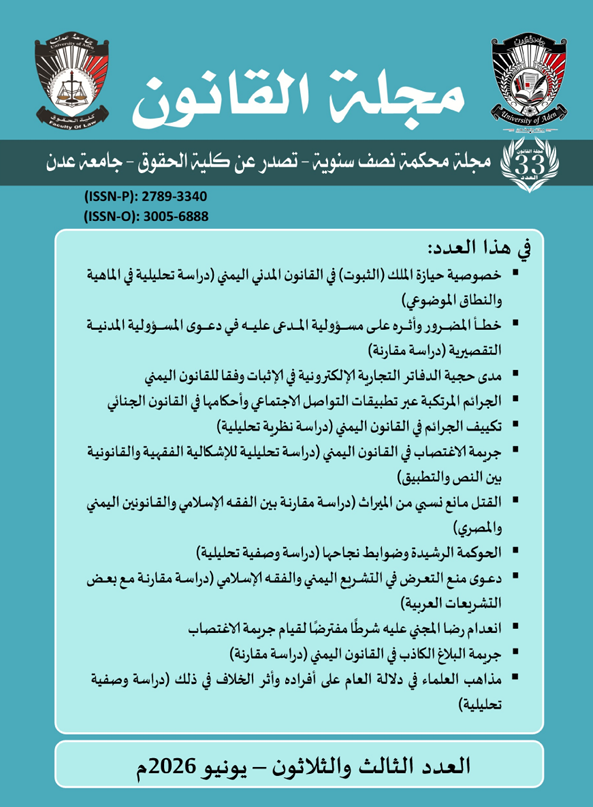
The victim's fault and its impact on the defendant's liability in a tort civil liability claim A comparative study
DOI:
https://doi.org/10.47378/6hhdwc87Keywords:
Overriding Fault; Civil Liability; Causation; CompensationAbstract
This study explores the role of the victim's fault and its legal consequences within the framework of civil liability. The issue is closely linked to the causal relationship between the defendant's fault and the harm suffered by the claimant. Even when the defendant's liability is established—whether through proven or presumed fault—they may seek exemption by demonstrating that the damage resulted primarily or entirely from the claimant's own actions, thereby presenting the victim's fault as an external and independent cause. The research aims to identify the legal nature of the victim's fault and analyze its impact on liability. The consequences of the victim's fault depend on how it interacts with the defendant's fault—whether one overrides the other (overriding fault) or whether both faults remain distinct yet contribute jointly to the damage. In cases of overriding fault, the prevailing rule is that liability is assigned to the party whose fault outweighs the other. If the defendant's fault overrides that of the victim, the defendant remains fully liable and must provide complete compensation, as their fault is deemed the sole effective cause of the harm. Conversely, if the victim's fault overrides the defendant's, the latter is relieved of liability due to the absence of a causal connection, and the victim bears full responsibility for the damage. When both parties' faults coexist independently—constituting contributory fault—the result is partial liability. In such cases, the defendant is obligated to compensate only to the extent of their own fault, and the victim's compensation is reduced proportionally to their contribution to the damage.
This research is structured into an introduction, four main sections, and a conclusion.
Section One discusses the legal nature of the victim's fault.
Section Two analyzes the concept and implications of overriding fault.
Section Three addresses cases of shared or contributory fault.
Section Four outlines the legal consequences arising from the victim's fault.
The study concludes with a summary of key findings and recommendations.
Downloads
Downloads
Published
Issue
Section
License

This work is licensed under a Creative Commons Attribution-NonCommercial 4.0 International License.
YY-CC-NC