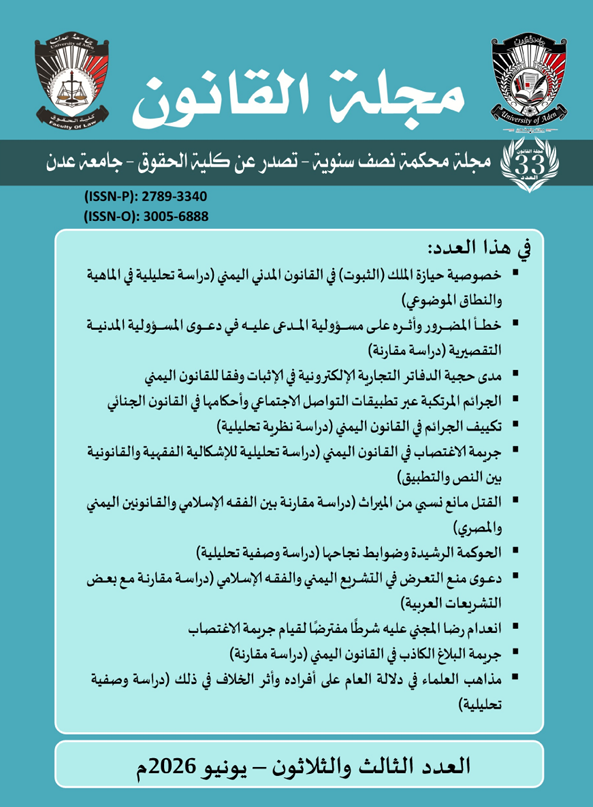
Killing as a Relative Disqualification from Inheritance: A Comparative Study of Islamic Jurisprudence, Yemeni and Egyptian Law.
DOI:
https://doi.org/10.47378/ayt3w176Abstract
In this study, I examine "homicide" as an impediment to inheritance, challenging its traditional grouping with absolute impediments like slavery or religious difference. Through a comparative analysis of Islamic jurisprudence and Yemeni and Egyptian laws, I demonstrate that homicide is a "relative impediment" that depends entirely on criminal intent, depriving the offender only of the victim's estate. My research highlights the injustice of treating accidental manslaughter the same as intentional homicide and reveals significant contradictions within current Yemeni legislation. Ultimately, I recommend adopting criminal intent as the primary criterion for inheritance deprivation and urgently amending Article (304) of the Yemeni Personal Status Law to resolve these legal gaps and ensure justice.
Downloads
Downloads
Published
Issue
Section
License
Copyright (c) 2026 Saleh Abdo Ali (Author)

This work is licensed under a Creative Commons Attribution-NonCommercial 4.0 International License.
YY-CC-NC