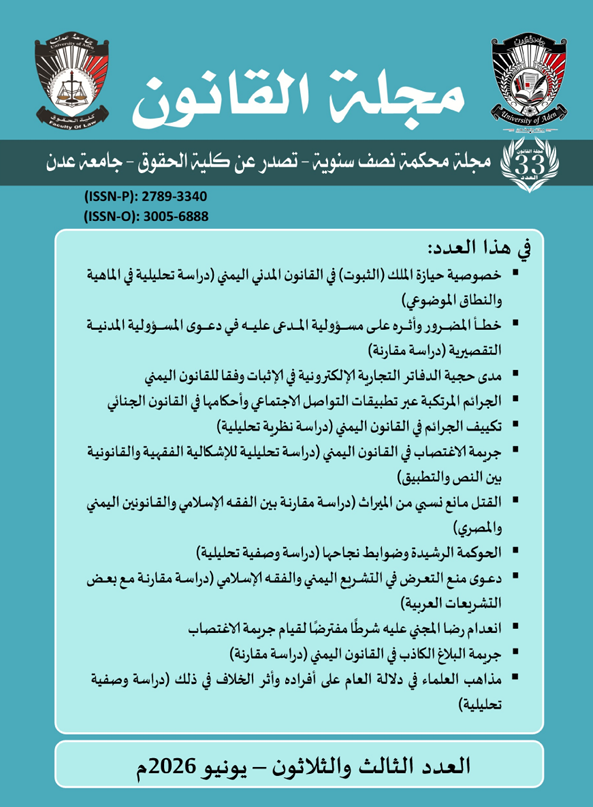
The Crime of Rape in Yemeni Law Jurisprudential and Legal Challenges between Legislative Text and Judicial Practice
DOI:
https://doi.org/10.47378/bgm25f10Keywords:
Rape, Coerced Zina, Islamic Jurisprudence, Yemeni Law, Criminal Justice, Forensic Evidence, Victim Protection.Abstract
This study aims to examine the jurisprudential and legal dilemma surrounding the crime of rape in Yemeni legislation by analyzing its Islamic and legal characterization and evaluating the adequacy of the existing legal framework in achieving criminal justice and protecting victims. The significance of the study stems from the controversy raised by Article (269) of the Yemeni Crimes and Penalties Law No. (12) of 1994, which links rape to the offense of zina (adultery) and the rules of hudud punishments, while subjecting it to discretionary punishment (ta'zir) when the conditions for the prescribed hadd punishment are not fulfilled. This legislative approach has generated substantial jurisprudential, legislative, and judicial challenges affecting the practical application of the law. The study employs descriptive-analytical, comparative, and critical methodologies. It analyzes relevant Islamic jurisprudential opinions and legal provisions, compares the different juristic approaches to the characterization of rape, and critically evaluates the effectiveness of the current Yemeni legal framework. The findings reveal that Islamic jurisprudence does not adopt a single approach regarding the legal characterization of rape. While the majority of jurists classify it as coerced zina, some scholars consider it a form of hirabah when accompanied by violence, intimidation, or public harm, whereas a number of contemporary jurists regard it as an independent criminal offense with a distinct legal nature. The study further finds that Yemeni legislation largely reflects the position of the majority jurists; however, the current wording of Article (269) creates ambiguity regarding the legal nature of rape, resulting in inconsistency between legislative intent and judicial application. Moreover, the prescribed penalties do not adequately correspond to the gravity of the offense and its severe psychological, social, and human consequences.The study concludes that comprehensive legislative reform is necessary by recognizing rape as an independent criminal offense, adopting a statutory definition centered on the absence of consent and the presence of coercion, strengthening penalties in proportion to the seriousness of the crime, expanding the use of modern forensic evidence, and enhancing legal and procedural safeguards for victims and witnesses. Such reforms would ensure a balance between the objectives of Islamic Sharia and the contemporary requirements of criminal justice.
Downloads
Downloads
Published
Issue
Section
License

This work is licensed under a Creative Commons Attribution-NonCommercial 4.0 International License.
YY-CC-NC