Energy Loss Analysis of Yemen National Grid For the Period 2000 – 2004
DOI:
https://doi.org/10.47378/m7h30718Abstract
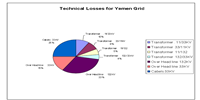
Energy losses occur in the process of supplying electricity to consumers due to technical and commercial (non-technical) losses. The technical losses are due to energy dissipated in the conductors and equipment used for transmission, transformation, sub-transmission and distribution of power. These technical losses are inherent in a system and can be reduced to an optimum level. These losses can be further sub- grouped depending upon the stage of power transformation and transmission system as Transmission Losses (400kV/220kV/132kV/66kV), as Sub-transmission losses (33kV/11kV) and distribution losses (11kV/0.4kV).
The commercial losses are caused by pilferage, defective meters, and errors in meter reading and in estimating unmetered supply of energy. This paper presented power flow using the Newton-Raphson method, and analyzed the technical and non-technical losses in the existing system (Yemen national grid), and in Aden Network for the period 2000-2004. The cost of the total energy loss in each year is calculated and compared, and the value of a 1% reduction of energy loss per year is determined as saving money in Rial Yemeni (R.Y). The paper concludes with conclusions and recommendations.
1. INTRODUCTION
Electric distribution losses may be divided into two types: i) Power losses, and ii) Energy losses. The power losses at the time of system peak increase the requirement of generating capacity, while the energy losses make it necessary to supply additional
energy over that required by the system load. Allocation of these losses may be made according to the general components of an electric system as follows: 1) Transmission system losses: a) high-voltage transformer losses b) transmission line losses c)
substation transformer losses. 2) Distribution system losses: a) primary-feeder and line equipment losses b) distribution transformer losses c) meter losses. Losses in transmission components are relatively simple to determine on account of the recording
meter readings generally available on both input and output terminals of these components. However, no comparable source of information is available on distribution system components, and the losses in them must be calculated from known circuit
parameters and loads. Moreover, although much has been published on the loss coefficients method of calculating transmission line losses in conjunction with load flow studies of power systems, few references were found on the subject of distribution losses.
Downloads
Downloads
Published
Issue
Section
License

This work is licensed under a Creative Commons Attribution-NonCommercial 4.0 International License.
This work is licensed under a Creative Commons Attribution-NonCommercial 4.0 International License.